the island’s long and mysterious history compares to what the team—led by Rick Lagina and Marty Lagina—has now reportedly uncovered deep beneath the surface: a strange, enigmatic object being called the “Quartz Chrono-Disc.”
the island’s long and mysterious history compares to what the team—led by Rick Lagina and Marty Lagina—has now reportedly uncovered deep beneath the surface: a strange, enigmatic object being called the “Quartz Chrono-Disc.”
The island’s long and mysterious history compares to what the team—led by Rick Lagina and Marty Lagina—has now reportedly uncovered deep beneath the surface: a strange, enigmatic object being called the “Quartz Chrono-Disc.”
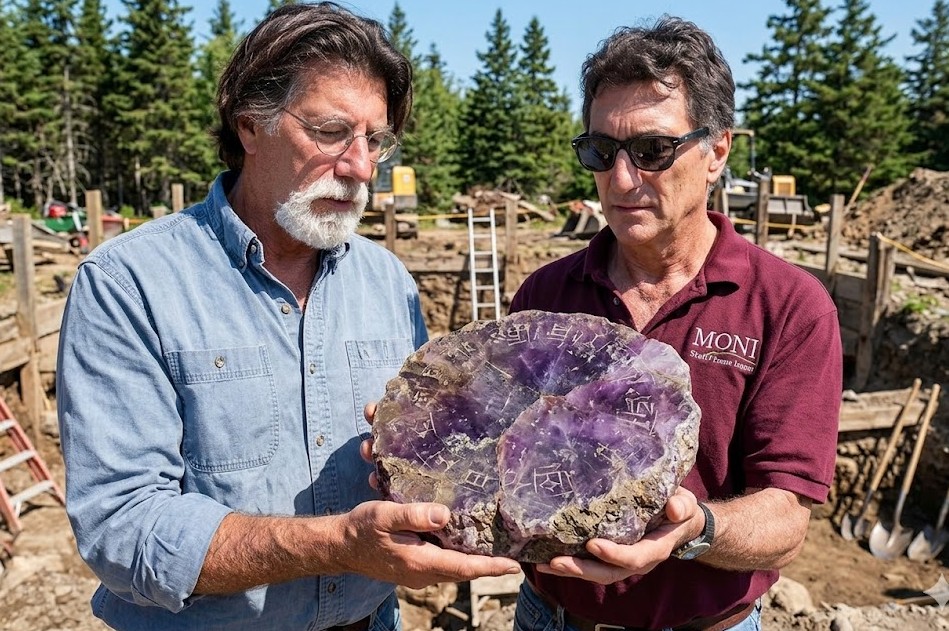
Discovered during a deep excavation below the Money Pit area, the object immediately defied expectations. Roughly circular in shape and composed of a translucent quartz-like material, the disc appears to have been intentionally crafted rather than naturally formed. Its surface is etched with intricate geometric patterns—symbols that do not correspond to any known language, culture, or historical period. Even more puzzling, the markings seem to shift subtly depending on the angle of light, as if designed to reveal different layers of meaning.
Initial analysis left the team stunned. Quartz is a common mineral, but the purity and structural consistency of this piece are highly unusual. Experts on-site noted that the disc’s symmetry and precision would be difficult to achieve even with modern tools, raising immediate questions about its origin. Was it created by an advanced ancient civilization? Or is it something entirely outside our current understanding of history?
The term “chrono-disc” emerged after preliminary tests suggested unusual interactions with electromagnetic fields. Instruments placed near the artifact reportedly experienced interference—fluctuating readings that could not be easily explained. Some team members speculated that the disc might function as a kind of ancient device, possibly linked to timekeeping, navigation, or even something far more complex. While such ideas remain unproven, they have fueled intense debate among researchers and viewers alike.
For the Lagina brothers, the discovery represents both a breakthrough and a challenge. Their mission has always been grounded in uncovering tangible history—coins, tools, structures that connect the island to known civilizations. But this artifact, if authentic, pushes the narrative into entirely new territory. It suggests that Oak Island may not just be a repository of hidden treasure, but a site connected to knowledge far beyond conventional timelines.




Skeptics, however, urge caution. Extraordinary claims require extraordinary evidence, and the scientific community will demand rigorous testing before accepting any conclusions. Detailed material analysis, dating techniques, and peer-reviewed studies will be essential to determine whether the Quartz Chrono-Disc is truly ancient—or something more recent and misunderstood.
Still, the excitement is undeniable. Even if the disc ultimately proves to have a more conventional explanation, its discovery has reignited global fascination with Oak Island. It serves as a reminder that the island continues to surprise, challenge, and inspire those who seek its secrets.
Whether the Quartz Chrono-Disc is a revolutionary artifact or an elaborate mystery waiting to be solved, one thing is certain: Oak Island has once again captured the imagination of the world—and the deeper the team digs, the stranger the story becomes.