Salary Cap Down to $243K, Bears Lose Former First-Round Pick to Eagles
Salary Cap Down to $243K, Bears Lose Former First-Round Pick to Eagles
Salary Cap Down to $243K, Bears Lose Former First-Round Pick to Eagles

Chicago, IL – March 2026
The Chicago Bears are now facing one of the most restrictive financial situations in the NFL, and it’s beginning to show in real time.
With just $243,000 in available salary cap space, the Bears currently rank dead last in the league, leaving the front office with virtually no flexibility to make meaningful roster additions in free agency.
That limitation has now directly impacted the defensive front.
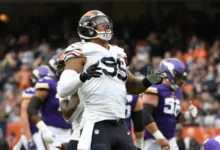



According to league sources, the Philadelphia Eagles have signed former Bears pass rusher Joe Tryon-Shoyinka to a one-year deal, taking advantage of a market opportunity Chicago simply could not act on.
Tryon-Shoyinka, a former first-round pick, was acquired by the Bears at last season’s trade deadline in exchange for a 2026 sixth-round pick. At the time, the move was seen as a depth solution during a stretch of injuries along the defensive line.
However, the results never followed.
He appeared in eight games but failed to record a single sack, finishing with 13 tackles and limited overall production. The move has since been widely viewed as a low-impact investment that failed to address the team’s pass-rush concerns.
Now, with no cap space to retain or re-evaluate him, Chicago has effectively lost the player without gaining any return.
The situation highlights a larger issue.
The Bears still have a clear need at edge rusher, but with no financial flexibility, free agency is no longer a viable path. That leaves the upcoming 2026 NFL Draft as the only realistic solution to fix the defensive front.
Internally, pressure is building for the front office to shift strategy. Rather than spending draft capital on uncertain veterans, the focus must now turn toward securing long-term talent through early-round selections.
For Bears fans, the message is becoming increasingly clear.
The team isn’t just losing players. It’s losing options.
And until the cap situation is corrected, moves like this may continue to define the offseason.